
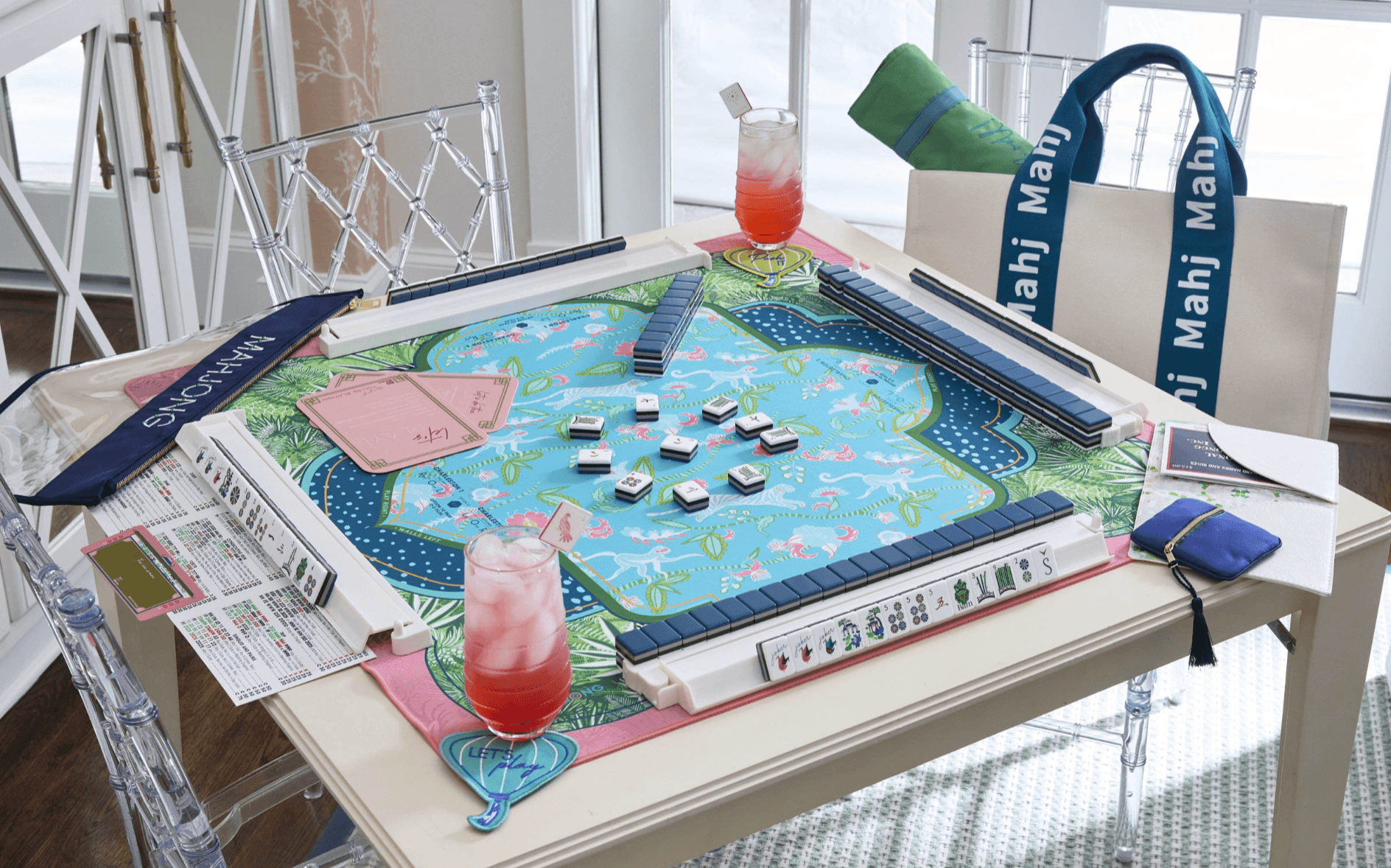

If you’ve ever sat down near a group of players who suddenly start saying things like “Charleston,” “joker,” and “Mah Jongg!”—you’re not alone if it felt like a different language.
This guide is here to translate.
By the end, you’ll understand what American Mah Jongg is (NMJL style), what you need to play, and what actually happens from the first tile pass to the moment someone calls “Mah Jongg!”
What makes American Mahjong different (NMJL style)
There are lots of mahjong versions around the world, but American Mah Jongg has a few defining traits.
First, it’s built around a yearly “hands card.” The National Mah Jongg League explains that American Mah Jongg “uses a card of Standard Hands… these cards are changed annually” in its overview of the game.
Second, the game starts with tile passing. NMJL describes that “the game is started with ‘Charleston’,” meaning the passing of three unwanted tiles from player to player.
Third, American Mah Jongg uses jokers as part of standard play. NMJL notes the game “uses more tiles, notably the Joker” and that jokers can help complete “quints and sextets” in some hands.
Put simply:
-
You’re not free-building any winning hand you like—you’re matching a hand listed on the current NMJL card.
-
You’ll pass tiles before regular play starts.
-
Jokers are part of the expected toolkit.
What you need to play American Mahjong
You can’t play comfortably without the basics. Here’s the beginner-friendly checklist.
Must-haves
1) The current NMJL card
This is the reference for what counts as a winning hand.
NMJL says it “supplies the Official Standard Hands and Rules Cards each year” on its page about the League. And you can see the yearly cycle directly in the NMJL store listings—like its note that it’s accepting orders for the “new 2026 card” on the official NMJL Store.
2) A full American mahjong tile set
American sets include jokers. (Some sets include extra “blank” tiles too.)
3) Four racks (one per player)
A rack is the tile holder in front of you. It keeps your tiles private while still easy to sort.
4) Two dice
These are used to determine where the break in the wall happens for dealing.
Pro Tip: If you’re learning how to play American mahjong, prioritize a clear NMJL card (standard or large print) and racks that feel stable. Those two things reduce beginner confusion more than anything else.
Nice-to-haves (helpful, not required)
-
A tile bag (for storage)
-
A mat or table cover (helps tiles slide and reduces noise)
-
Pushers (little sticks that help move tiles around)
-
A “cheat sheet” of terms (you’ll build your own after a few games)

The key terms you’ll hear at the table
American Mah Jongg sounds fast because players use shorthand. Here’s the plain-English version.
-
The wall: The big square of stacked tiles at the start of the game.
-
The break: Where the wall is opened to start dealing.
-
Your hand: The tiles on your rack.
-
Discard: A tile you throw into the middle, face up.
-
Exposure (an exposed set): Tiles you lay on top of your rack for everyone to see, usually because you called a discard.
-
Joker: A “wild” tile used in many American hands. (There are rules about where it can and can’t be used.)
-
Charleston: The opening pass where everyone trades three tiles at a time.
-
Courtesy pass: A small optional pass after the Charleston, usually across the table.
-
“Mah Jongg!”: What you say when you have a complete winning hand that matches a pattern on the card.
How to play American mahjong: the flow of a typical hand
American Mah Jongg has a rhythm. The details can vary a bit by group (house rules exist), but this is the sequence beginners should expect.
1) Set up the wall
Players mix tiles face-down and build the wall: each player builds a two-high “wall” in front of them. The four walls form a square.
2) Deal tiles
Two dice are rolled to decide where to “break” the wall and start dealing.
The dealer (often called East) starts with one extra tile compared to the other players.
Don’t worry if dealing feels mysterious at first—most groups will happily deal for you while you learn. Your job is simply to:
-
keep your tiles faced toward you
-
sort them into suits
-
start looking at the NMJL card for a hand that fits
3) Do the Charleston (the opening tile pass)
American mahjong Charleston is the part that surprises most new players.
The NMJL describes that the game starts with the Charleston, meaning the passing of three unwanted tiles among players.
In many beginner-friendly games, the Charleston works like this:
-
Everyone chooses three tiles they don’t want.
-
Everyone passes those three tiles at the same time.
A common way it’s taught is a six-pass pattern often remembered as right, across, left, left, across, right (with the second three passes done only if everyone agrees).
For a beginner-oriented explanation of those passes and the optional courtesy pass, see I Love Mahj’s beginner guide to American Mah Jongg.
⚠️ Warning: Don’t be surprised if your group has Charleston “house rules.” If you’re unsure, ask, “Are we doing a full Charleston and courtesy pass?” before the first pass starts.
4) Choose your target hand on the NMJL card
This is the part that’s uniquely American.
Instead of inventing a hand, you pick a printed hand from the current NMJL card and work toward it.
Beginner approach:
-
Look for a hand with tiles you already have multiples of (pairs and triples are a good sign).
-
Try to keep two possible hands in mind early, so you don’t paint yourself into a corner.
-
Avoid committing too hard until you’ve seen a few turns and discards.
5) Take turns: draw, then discard
Once play starts, each turn is simple:
-
Draw one tile from the wall.
-
Decide whether it helps your chosen hand.
-
Discard one tile face-up into the middle.
As you play, you’ll keep adjusting your plan based on:
-
what you draw
-
what you see other people discarding
-
whether you’re close to completing your hand

6) Calling a discard (and making exposures)
Sometimes someone discards a tile you need.
If you can legally use that tile to build your target hand, you can call it (often by saying the tile name and “call”). When you call a discard, you take it and place the completed set as an exposure on top of your rack.
Two beginner-safe reminders:
-
Calling makes your hand more obvious to other players, which can make it harder to get your last needed tiles.
-
Some hands on the NMJL card are marked as concealed (often shown with a “C”). Those typically require you to keep everything hidden until the end.
If your group is new-player friendly, ask: “Are concealed hands allowed today, or are we playing open hands only?”
7) Declaring “Mah Jongg!”
You can declare when your tiles match a hand on the card.
This is the moment where precision matters: American Mah Jongg is not “close enough.” Your hand needs to match a pattern as printed (right number of tiles, right suits, and the right structure).
When you think you have it:
-
say “Mah Jongg!”
-
show your tiles
-
let the table confirm it matches the NMJL card
The beginner mistakes that cause the most confusion
You can avoid a lot of frustration by watching for these.
Mistake 1: Treating the NMJL card like a suggestion
In American Mah Jongg, the NMJL card isn’t a menu of ideas—it’s the rulebook for what counts as a winning hand.
Fix: pick a hand and keep checking your tiles against the printed pattern.
Mistake 2: Locking into a hand too early
Early hands can look promising… until you realize the tiles you need are already out.
Fix: keep two options open until you’ve got a clear path.
Mistake 3: Calling everything that looks helpful
New players often call too many tiles early because it feels productive.
Fix: call with a plan. If calling exposes your direction and you’re not close to winning, you may make your last tiles harder to find.
Mistake 4: Mixing up mahjong “versions” mid-game
If you learned a little Chinese or Riichi mahjong online, it’s easy to bring those assumptions to an American table.
Fix: remember the three big American differences: annual hands card, Charleston, and jokers.
American Mahjong vs Chinese Mahjong (and Riichi): the quick comparison
If you’re learning from videos or friends, this section helps keep your mental model clean.
-
American Mah Jongg (NMJL): You match a hand on the yearly card; the game starts with the Charleston; jokers are used.
-
Chinese mahjong (many styles): Players typically build “standard” hand shapes without a yearly card and without jokers.
-
Riichi (Japanese mahjong): Players aim for specific scoring patterns (yaku), and the strategy is heavily tied to probability and defense.
This is why the best advice when you’re brand new is: learn one version at a time. If your local group plays NMJL, learn NMJL first.
FAQ
Do I really need the current NMJL card?
If you’re playing NMJL-style American Mah Jongg, yes—the card defines the legal winning hands and changes annually.
Is the Charleston always required?
The NMJL describes that the game starts with the Charleston, but some groups shorten or modify it. It’s always fair to ask what your table does.
Are jokers always used?
In American Mah Jongg, jokers are a defining feature and can be used for larger groupings like quints and sextets.
What if my group plays “house rules”?
That’s normal. Many groups keep NMJL as the foundation but tweak a few details for speed or comfort.
If you’re learning, ask two questions upfront:
-
“Are we playing strictly by the current NMJL card?”
-
“Are there any house rules I should know before we start?”
Next steps (so you can actually play)
-
Get the current NMJL card (standard or large print) from the official NMJL store.
-
Watch one full beginner game so you can see the rhythm of turns.
-
Play a “practice hand” with open tiles—no pressure, just learn the flow.
Once the flow feels familiar, then start learning the finer points: reading the card faster, understanding concealed hands, and using exposures strategically.
Note: This article is a beginner overview. For official definitions and the NMJL’s description of American Mah Jongg, refer to the NMJL’s official pages (linked earlier in this guide).
Share: